 Skip to content

Every week, companies ask the same question: “Can you add AI to our business?”, “Will AI help cut costs?”
The request is common. The readiness is not.
Most businesses want AI because they believe it will automate everything, reduce headcount, and cut costs. But AI does not work that way. It depends heavily on business maturity, process clarity, and data consistency. To understand what AI can actually do, we must first look at where a business sits on the maturity curve.
The Real-World Business Maturity Model
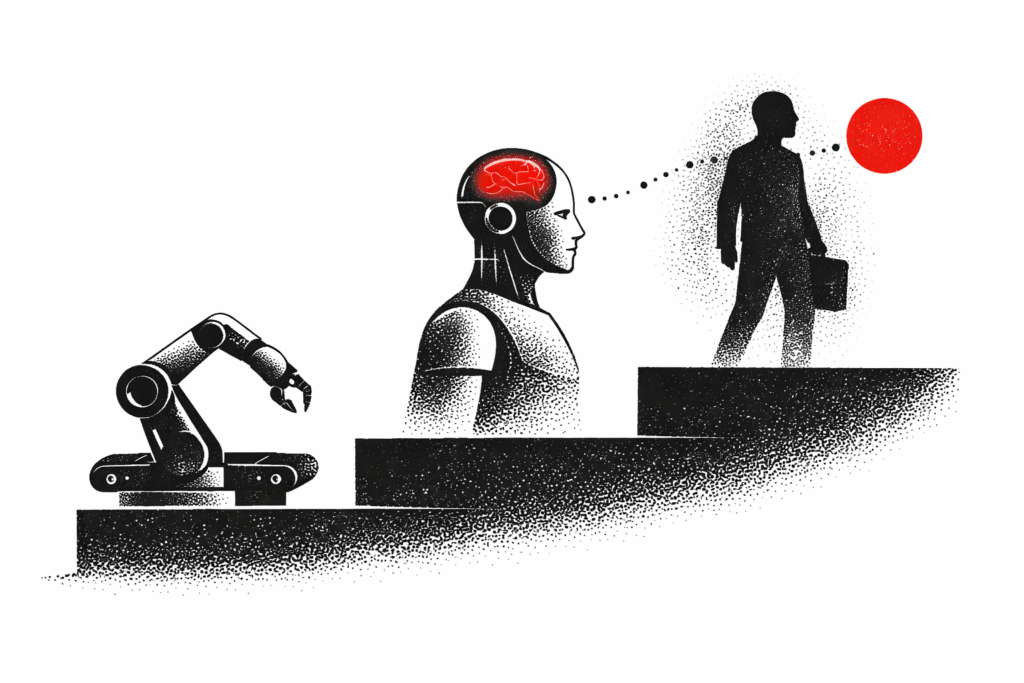
This model describes how businesses actually operate, not how they imagine they operate. The truth is simple: AI helps individuals at low maturity, helps the business at mid maturity, and becomes the product itself only at high maturity.
Here is how AI usefulness changes across the five levels of maturity, mapping directly to your organizational capabilities:
1. Ad hoc Stage (Low Maturity)
- Capability Involved: None (No system integration)
- The Reality: Work is manual, inconsistent, undocumented, and entirely dependent on individuals.
- How AI Helps: It serves strictly as a personal productivity tool. Because AI cannot integrate with underlying business systems at this stage, it helps individuals summarize emails, rewrite documents, generate ideas, create templates, assist with research, and draft reports.
- The Bottleneck: AI cannot help the business entity because workflows are undefined, data is scattered, and nothing is standardized. AI cannot automate chaos.
2. Repeatable Stage (Low-to-Mid Maturity)
- Capability Involved: Light Automation (Manual Triggers, No ML)
- The Reality: Teams begin doing tasks in similar ways, but processes are still not formally documented or deeply integrated.
- How AI Helps: It assists small teams in aligning on process by drafting Standard Operating Procedures (SOPs), summarizing meetings, standardizing templates, and supporting small, manually-triggered data tasks.
- The Bottleneck: AI still cannot support core company operations because data remains inconsistent and systems are completely siloed. It helps people work better, but it does not run the business.
3. Defined Stage (Mid Maturity)
- Capability Involved: Automation + Machine Learning
- The Reality: This is the milestone where data becomes structured enough that AI finally helps the business operational layer.
- How AI Helps: AI transitions from a personal assistant to a workflow enhancer. It pairs rule-based automation with statistical pattern recognition to extract data from invoices, classify corporate documents, summarize customer conversations, enrich features for analytics, and assist in data pipelines (ETL).
4. Managed Stage (Mid-to-High Maturity)
- Capability Involved: AI-Enabled Workflows (AI Supports, Does Not Replace)
- The Reality: Systems are fully integrated, data pipelines are reliably established, and KPIs are measurable.
- How AI Helps: AI becomes an enterprise-wide business capability. It actively supports and enhances entire operational workflows without replacing the core human processes, providing predictive organizational insights, supporting executive decision-making, and scaling customer experience improvements.
5. Optimized Stage (High Maturity)
- Capability Involved: AI Product (AI is the Core Value)
- The Reality: AI transitions from a supportive background layer to the actual product and value engine of the company.
- How AI Helps: Only at this highly optimized stage can a company successfully build proprietary AI-driven analytics platforms, intelligent autonomous agents, predictive engines, and conversational interfaces where AI represents the core product offering.
AI Usefulness & Capabilities
The table below synthesizes how business maturity aligns with technological capabilities and real-world execution:
| Business Maturity | Who AI Helps | Capability Involved | What AI Can Do | Real-World Example |
| Ad hoc | Individuals | None (No system integration) | Summaries, ideation, writing, personal speed. | An employee uses ChatGPT to summarize emails or draft a proposal. |
| Repeatable | Individuals & small teams | Light Automation (Manual triggers, no ML) | SOP drafts, meeting notes, template standardization. | A team drafts SOPs with AI, but monthly reports require manual CSV exports. |
| Defined | Business workflows | Automation + Machine Learning | Data extraction, document classification, ETL support. | AI extracts invoice data, and a rule-based system automatically posts it to accounting. |
| Managed | Business & product | AI-Enabled Workflows (AI supports, does not replace) | Insights, advanced automation, predictive CX. | AI summarizes customer calls, feeds the CRM, and triggers custom follow-up loops. |
| Optimized | Product itself | AI Product (AI is the core value) | Predictive engines, generative features, custom platforms. | A conversational analytics platform generating insights directly from raw data. |
Automation vs. AI in the Real World
Most clients mistakenly believe that AI = Automation = Cost Reduction. In reality, they are entirely different mechanisms that work better together:
- Automation is deterministic. It strictly follows rules and executes predictable tasks.
- AI is probabilistic. It interprets patterns to predict, classify, summarize, or generate.
Automation Can Exist Without AI
A well-designed, rule-based system can fully automate accounting workflows, P&L calculations, inventory reordering, payroll, compliance checks, and data validation. These systems do not need AI; they simply need operational clarity, strict rules, and predictable inputs.
The Blueprint: An AI-Enabled Business
Many clients believe they need to build an AI Product because investors ask about it, competitors talk about it, and the market rewards AI narratives.
However, the correct answer is rarely to build an AI product. The correct answer is to build an AI-enabled business. AI should accelerate your workflow, not replace it.
Example: An accounting automation product runs entirely on deterministic rules. AI acts as the accelerator by extracting raw data from invoices, summarizing transactions, and classifying expenses. The product itself is not AI; the product is accounting automation. AI is simply the engine behind it.
Modern AI Tools Supporting Daily Workflows
Achieving an AI-enabled business flow is easier than ever because modern tools drastically reduce the technical barrier to adoption. Instead of writing custom code for basic tasks, teams can use configuration-driven platforms to analyze data, streamline productivity, or build internal workflows instantly.
- ChatGPT by OpenAI (Personal & Team Productivity Sandbox):
- Capability: Serves as a versatile natural language interface for individual or team-wide ideation, writing, and unstructured data structuring.
- Real-World Example: A marketing executive copy-pastes a chaotic, 2,000-word transcript from a brainstorming session into ChatGPT and prompts: “Turn this mess into a structured product brief with a clear background, key feature bullets, and five potential taglines.” Within ten seconds, ChatGPT delivers a highly organized document ready to share with the creative team.
- PartyRock (Rapid Prototyping & Sandbox Testing):
- Capability: A free, zero-code environment powered by Anthropic Claude that allows anyone to upload unstructured data (up to 120,000 characters) to extract summaries, trends, and structures.
- Real-World Example: A marketing coordinator uploads a massive CSV file containing raw customer feedback from a recent product launch. Within seconds, they build an app that separates the data into positive vs. negative sentiment, drafts personalized email responses for the frustrated customers, and translates the feedback into structural feature requests for the product engineering team.
- Data Analysis with Amazon Q (Enterprise Insights):
- Capability: Merges completely unrelated enterprise datasets using plain English, backed by AWS Nova and Anthropic Claude.
- Real-World Example: A regional sales manager asks, “Compare our Q3 CRM pipeline data in Salesforce with the actual product usage logs sitting in our AWS database to show me which accounts are at risk.” Amazon Q automatically writes the backend queries, merges the datasets, and outputs a prioritized customer churn risk report.
- Chatbot Creation via Bedrock & Lex (Instant Knowledge Bases):
- Capability: Automatically builds an intelligent, data-aware chatbot without writing any custom code.
- Real-World Example: An HR team drops 400 pages of scattered PDF employee handbooks, health insurance policies, and compliance guidelines into an Amazon S3 bucket. AWS automatically spins up a secure vector database, links it to Claude, and deploys an internal chat interface where employees can instantly ask, “What is our policy on paternity leave for international transfers?”
- AWS SageMaker (Enterprise Machine Learning & Custom AI Products):
- Capability: Provides a fully managed infrastructure for building, training, fine-tuning, and deploying proprietary machine learning models and large language models (LLMs) at scale.
- Real-World Example: A fintech company uses SageMaker to train a custom fraud-detection model on tens of millions of historical transaction logs. The proprietary model is deployed into their live production pipeline, flagging suspicious credit card charges with millisecond latency and running custom reinforcement learning loops to continuously adapt to new fraud patterns.
Tool Alignment Across the Business Maturity Spectrum
Different tools require different levels of data consistency and infrastructure maturity to be useful. The table below maps where these modern tools fit, ensuring you don’t deploy an advanced tool onto a chaotic foundation:
| Business Maturity Stage | Capability Involved | Recommended Modern AI Tools | How the Tool Operates at This Level |
| Ad hoc | None (Siloed Individual Productivity) | ChatGPT, Claude Pro, Gemini Advanced | Used entirely as a sandbox app for individual tasks (e.g., rewriting drafts, brainstorming, summarizing emails). No system integrations required. |
| Repeatable | Light Automation (Manual triggers, no ML) | PartyRock, Notion AI, Microsoft Copilot (Basic) | Used by small teams to build ad-hoc templates, draft recurring SOP guidelines, and summarize specific meeting transcripts manually. |
| Defined | Automation + Machine Learning | Amazon Q, Document AI, Zapier AI | Securely connects to structured, documented company datasets. Automatically extracts data fields from documents and transforms them to fit defined business rules. |
| Managed | AI-Enabled Workflows (AI supports, does not replace) | AWS Bedrock + Lex, Salesforce Einstein, HubSpot AI | Integrated deeply into live corporate pipelines (CRMs, ERPs, S3 Buckets). AI automatically monitors live data, updates records, and triggers automated follow-up sequences. |
| Optimized | AI Product (AI is the core value) | AWS SageMaker, LangChain, Custom API Frameworks | Used to build, fine-tune, and deploy proprietary AI algorithms and autonomous agents that directly serve external customers and B2AI systems. |
AI Must Add Revenue Value, Not Just Cut Costs
The market does not reward companies that use AI merely to reduce headcount; it rewards companies that use AI to generate new revenue.
Take Cloudflare as a prime example. When they announced AI-related restructuring, the market punished them because the move looked like basic, short-sighted cost-cutting rather than a play for new product value or top-line revenue growth. AI should expand your capabilities and uncover hidden markets, not just shrink your payroll.
But what is the next major revenue channel unlocked by AI? More importantly, what is the cost of falling behind?
If your business views AI strictly as an internal efficiency tool, you are setting yourself up for a massive, structural loss. While you focus on shaving pennies off your operational costs, the paradigm is shifting entirely. The real business threat, and the biggest financial opportunity, is no longer about making your human staff faster. It is about capturing a massive, unmapped ecosystem of programmatic buyers.
The Strategic Shift: From AI Ready to Agent Ready
Most companies ask, “Are we AI ready?” That is no longer the right question.
Traditional AI Readiness focuses purely on internal efficiency, like cleaning data, documenting workflows, laying automation foundations, and upgrading integration maturity. While these steps are necessary, they are no longer sufficient.
The real transformation is occurring externally: Your next customer may not be human; your next buyer may be an AI agent. This is the massive commercial shift from being AI Ready to being Business-to-AI (B2AI) Ready.
- AI Ready: Focuses Internally (Optimizes Employee Workflows)
- B2AI Ready: Opens Externally (Exposes Machine-Readable Surfaces)
What Business-to-AI Ready Actually Means
An “AI Agent buyer” is not a futuristic concept; it is an active economic channel utilizing specialized infrastructure landing today. Rather than navigating the web like a human, autonomous agents operate as independent software actors driven entirely by logic, policy, and strict parameters to execute transactions instantly.
To capture this automated market, your business must expose machine-readable surfaces (such as structured APIs and clear schemas) that autonomous software can seamlessly understand, trust, and interact with. Instead of rewriting your entire codebase, becoming “Agent Ready” means architecting your digital pipeline to support the modern, agent-native tech stack:
- Cryptographic Identity (KYC for Software): Integrating with open standards like the x402 protocol to instantly parse machine-readable mandates, verify an agent’s provenance, and authenticate its authority to act on behalf of a human or enterprise.
- Handling Programmatic Paywalls: Structuring your web endpoints to serve native machine-facing feedback, such as encountering an HTTP 402 (Payment Required) status code, which an agent’s reasoning loop can interpret automatically.
- Enterprise-Grade Agent Payments: Ensuring your systems can natively interact with managed financial substrates like Amazon Bedrock AgentCore Payments to settle transactions via identity-bound wallets, enforce programmable spending limits, and process friction-free microtransactions.
- Data-Driven Discovery: Replacing emotional branding hooks with flawless, highly structured product catalogs and metadata metadata. Agents select vendors based on verifiable trust signals, strict performance metrics, and policy constraints rather than catchy logos or visual marketing.
The Third Commercial Channel
B2AI introduces a completely new revenue stream, transforming how we view market access:
- B2C (Business-to-Consumer): Selling directly to human individuals.
- B2B (Business-to-Business): Selling to human-led organizations.
- B2AI (Business-to-AI): Selling directly to autonomous software agents.
| Strategic Lens | AI Ready (Internal) | Business-to-AI Ready (External) |
| Core Focus | Your business can use AI. | AI agents can use your business. |
| Primary Target | Helps your employees work faster. | Helps procurement, financial, and shopping agents buy from you. |
| Financial Impact | Reduces operational costs. | Unlocks entirely new revenue channels. |
Key Takeaways
- Maturity Dictates Utility: AI serves individuals at low maturity, enhances business workflows at mid maturity, and powers core products only at peak maturity.
- Stop Automating Chaos: AI is probabilistic (pattern-based) and cannot fix broken workflows; deterministic (rule-based) automation must be established first.
- The Revenue Imperative: The market punishes companies using AI merely for headcount cost-cutting. True value lies in deploying AI to expand top-line capabilities.
- The B2AI Paradigm Shift: Internal “AI Readiness” only lowers operational expense. External “Business-to-AI Readiness” builds machine-readable infrastructure to capture the emerging economy of autonomous software buyers.
About the Author
Jonathan Wong is an IT and AI consultant with 20+ years of experience leading engineering teams across Vancouver and Hong Kong. He specializes in modernizing legacy platforms, cloud security, and building AI-ready systems for startups and large enterprises while advising leadership on using strategic technology to drive business growth.
Connect with me on LinkedIn