Skip to content

Part 2 of the series: “Engineering Next-Gen AI Agents: Reflections on the Future AWS Agent Engineer Nanodegree”
In my previous post, I shared the milestone of completing the Future AWS Agent Engineer Nanodegree, sponsored by the AWS AI & ML Scholars Program. But before diving into complex multi-agent architectures and production-grade tool orchestration, every scholar had to build a rock-solid foundation.
The program was structured into two distinct parts:
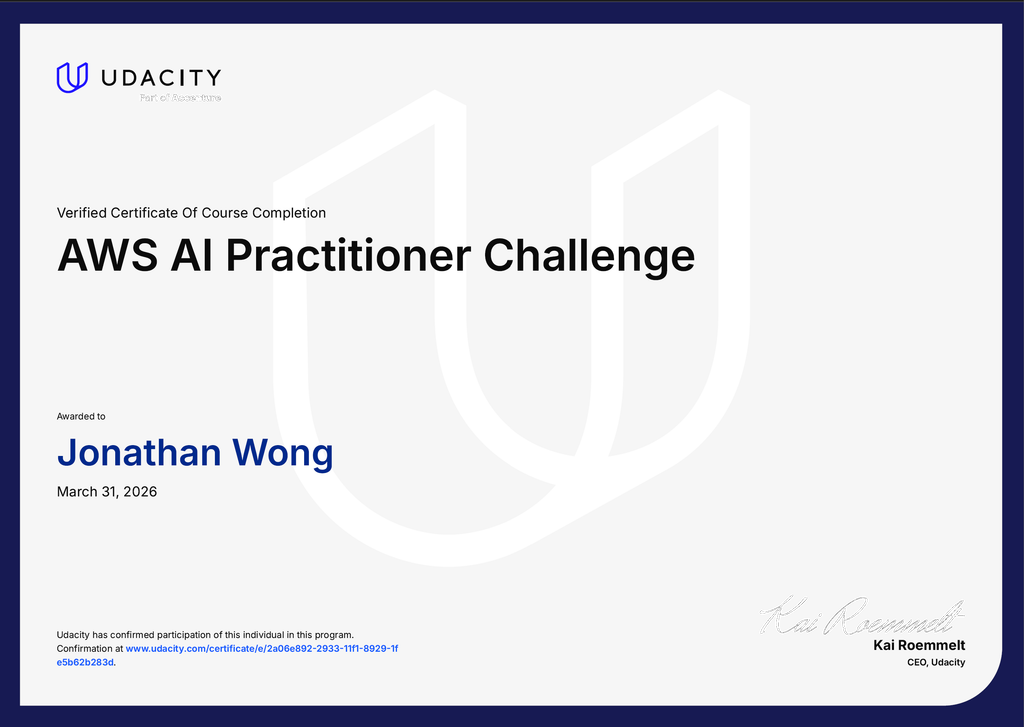
- The Challenge Phase (AWS AI Practitioner Challenge)
- The Nanodegree Phase (Future AWS Agent Engineer Track)
In this installment, we look at how the journey began, starting with foundational AI learning and rapid prototyping.
Step 1: The Challenge Phase & AWS AI Practitioner Learning Plan
The gateway into the scholarship was the AWS AI Practitioner Challenge. Rather than diving straight into raw code and backend API configuration, the program kicked off with structured, self-paced training mapped directly to the AWS AI Practitioner Learning Plan.
For experienced engineers and technology leaders, this phase served as an essential baseline refresh on how AWS approaches cloud-native artificial intelligence. It covered:
- The core spectrum of foundational models available on AWS.
- Responsible AI frameworks, security, and governance in cloud environments.
- The foundational mechanics of Retrieval-Augmented Generation (RAG) and prompt engineering before scaling up to autonomous agents.
Step 2: From Theory to Application with AWS PartyRock
To graduate from the Challenge Phase and secure a spot in the selective Nanodegree track, participants had to transition immediately from theory to execution by building functional generative AI applications.
The tool of choice for this rapid prototyping phase was AWS PartyRock (powered by Amazon Bedrock)—a generative AI app-building playground that allows creators to rapidly build working functional prototypes without getting bogged down in boilerplate code.
Building in PartyRock wasn’t just about playing with prompts; it forced a shift in mindset regarding application composition:
- How do you structure multi-step prompt chains to guide an LLM toward a specific output?
- How do you combine multiple models and widgets to create a cohesive user experience?
- How can rapid cloud prototyping validate a product concept before writing a single line of production code?
I documented the deep-dive architectural review and lessons learned from building those initial PartyRock applications in my previous write-up:
Read the full breakdown: What We Learned from Building Two PartyRock Apps
Crossing the Threshold: Into the Nanodegree
Successfully completing the PartyRock build projects marked the finish line of the Challenge Phase—and the ticket into the highly competitive Future AWS Agent Engineer Nanodegree program (reserved for top performers in the cohort).
Clearing this initial hurdle proved that rapid prototyping and cloud-based AI literacy were fully locked in. But it also set the stage for a massive leap forward: moving away from single-window prompt interfaces and static playground apps into stateful, tool-wielding, autonomous agent engineering.
What’s Next in the Series?
Now that the foundational baseline was established, the real engineering work began.
In next article, we will cross into Part 2 of the program, exploring Amazon Bedrock AgentCore, building a customer support chatbot with active API action groups, and designing an AI support agent equipped with real memory and tool execution.