 Skip to content

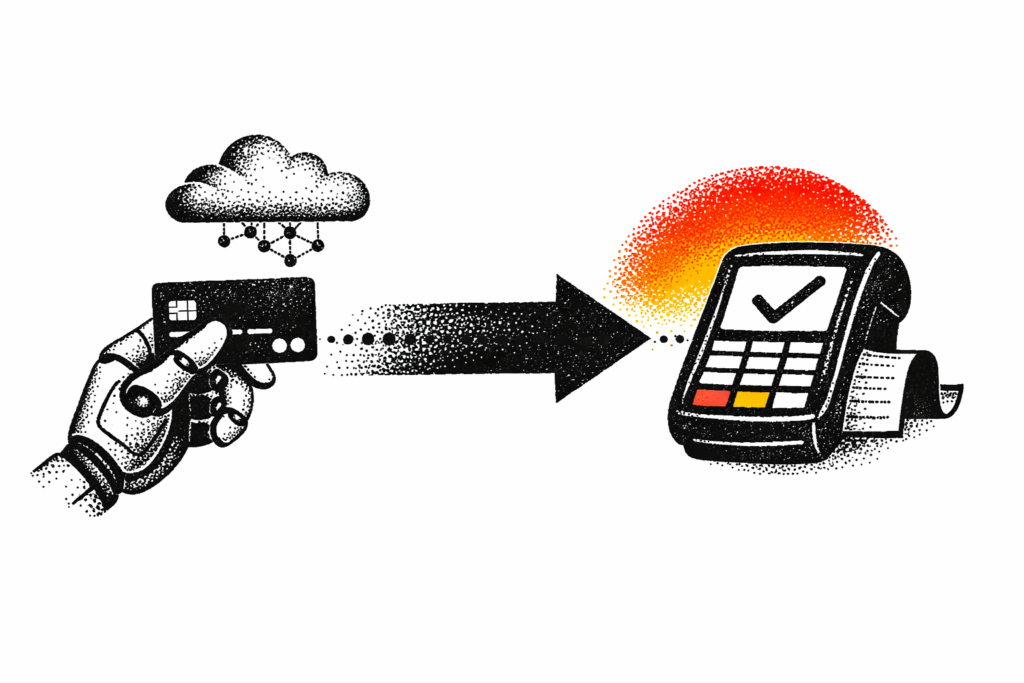
The story of digital payments has always been a story about movement.
Not just the movement of money, but the movement of the place where intention begins, where authentication happens, and where the transaction is finally executed.
Amazon’s introduction of Amazon Bedrock AgentCore Payments marks the beginning of a new chapter in that story. It is a chapter where AI agents no longer wait for users to initiate payments. Instead, they transact autonomously, safely, and with full governance. And to understand why this matters, we need to look at how the interaction surface has been moving for more than two decades.
A New Foundation for Agent Payments
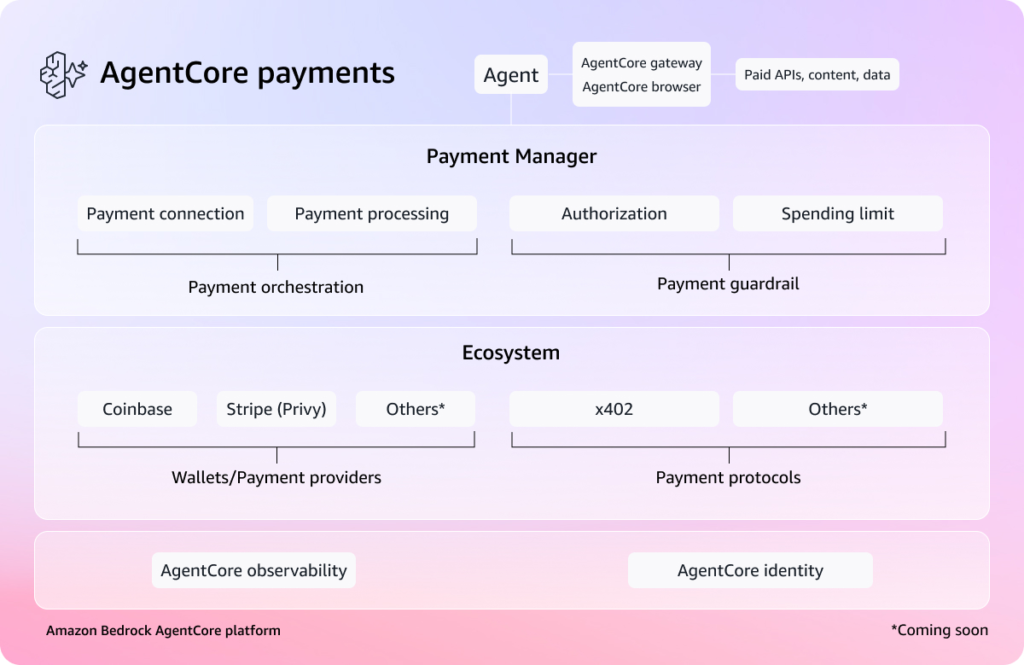
AgentCore Payments is a fully managed payment layer that allows AI agents to pay for APIs, data, MCP servers, and even other agents. It integrates Coinbase and Stripe to support microtransactions, stablecoin payments, identity bound wallets, spending guardrails, and full observability.
In the past, building this kind of payment capability required months of engineering work. Wallet management. Compliance. Guardrails. Billing logic. Error handling. AgentCore Payments removes all of that complexity. Payments become part of the agent execution loop, not a separate system bolted on the side.
This shift becomes clear when we look at how an agent handles a simple request such as analyzing Amazon stock.
How It Works
Once the agent realizes it needs paid data, the rest of the process is handled entirely by AgentCore Payments. The system provides a complete payment foundation inside the agent execution loop. It connects wallets, executes microtransactions, enforces spending rules, and records every event for governance and audit.
AgentCore Payments includes five core capabilities that work together as a single runtime layer.
Payment orchestration
The platform manages wallet connections, establishes secure sessions with providers such as Coinbase and Stripe, and executes payments on behalf of the agent.
Payment guardrails
Every transaction is checked against authorization rules and spending limits. This prevents runaway costs and ensures the agent stays within the boundaries defined by the user or the organization.
Unified identity for agents
Each agent operates under a consistent identity that ties together permissions, wallet access, and spending policies.
Observability across all payment events
Every payment attempt, success, failure, and retry is logged. This gives teams full visibility into how agents are spending and why.
Native integration with agent execution loops
Payments are not an external system. They are part of the agent’s reasoning and tool calling cycle. This allows agents to autonomously discover, evaluate, and pay for resources as part of completing a task.
Example: Analyze Amazon Stock Enquiry
A user asks the agent to analyze Amazon stock.
The agent determines that real time financial data is required, and that the data source is paid.
It reaches out to the provider.
At that moment, AgentCore Payments takes over.
It authenticates the wallet.
It executes the microtransaction.
It checks spending guardrails.
It logs the entire event for observability.
Once the payment clears, the agent receives the data.
It completes the analysis and returns the result to the user.
This example demonstrates the core value of AgentCore Payments.
Agents can autonomously transact inside a single execution loop without any custom payment logic.
Interaction Surface Mobility
A Short Explanation
To understand why this shift is so significant, we need a new lens.
Historically, people talked about device mobility. Desktop to laptop to mobile to wearables. But the real story is not about devices. It is about the interaction surface. The place where intention originates, where authentication happens, and where payments are triggered.
Interaction Surface Mobility describes how this surface keeps moving closer to the user’s life.
From the desk.
To the pocket.
To the environment.
And now into the cloud, where AI agents act on our behalf.
This mobility shapes how payments work, how businesses design services, and how value flows across digital ecosystems.
The Four Eras of Interaction Surface Mobility
Before we explore the eras, it helps to understand the underlying structure.
Payment flows follow a consistent pattern:
Interaction surface → service starting point → intention → authentication → channel
This formula becomes the backbone for understanding how payments evolve as the interaction surface becomes more mobile and more embedded in daily life.
But what is actually changing in this new era?
The primary shift is the movement of the interaction surface itself.
As the interaction surface moves, everything downstream changes with it.
The service starting point moves.
The intention model changes.
The authentication model changes.
The payment channel changes.
The interaction surface is the driver.
The rest of the flow is the consequence.
With this causal structure in mind, the four eras become clear.
The Evolution of Interaction Surface Mobility
| Era | Interaction surface | Service starting point | Intention | Auth | Channel |
| Desktop Web | Desktop | Website | User initiated | Manual login | Web payment page |
| Mobile App | Mobile phone | App | User initiated | Biometric | Mobile wallet |
| Cloud AI Services | Cloud agents | Cloud workflows | AI interpreted | Pre authorized agent identity | Agent to agent payment service |
| Ambient AI | Ambient compute | Autonomous AI workflows | AI reasoning | Identity bound spending guardrails | Autonomous payment protocols |
Era 1: The Desktop Web
In the beginning, the interaction surface was fixed.
People sat at a desk, opened a browser, and intentionally navigated to a payment page. Every action was explicit. Every step was manual. Payments were a destination, not a flow.
This era shaped the first generation of online commerce. But it was limited by the immobility of the interaction surface. The user had to go to the computer. The computer never followed the user.
Era 2: The Mobile App
Then the interaction surface moved into the pocket.
The phone became the center of digital life.
Apps replaced websites.
Biometrics replaced passwords.
Wallets replaced card forms.
Payments became faster, more personal, and more contextual.
This era created ride hailing, food delivery, and mobile commerce.
It also marked the beginning of lifestyle mobility.
People no longer went to the payment interface.
The payment interface went with them.
Era 3: Cloud Based AI Services
The next shift was subtle but profound.
The interaction surface moved off the device entirely and into the cloud.
AI agents began performing tasks on behalf of users.
They interpreted intention.
They initiated workflows.
They accessed paid resources.
But payments were still a problem.
Agents could not pay for anything without custom engineering.
Wallets were not agent native.
Guardrails were not standardized.
Governance was fragmented.
AgentCore Payments solves this.
It gives agents a native way to transact, with identity, guardrails, and observability built in.
This is the first real payment system designed for autonomous agents.
Era 4: Ambient AI
This is the era we are entering now.
The interaction surface becomes the environment itself.
Homes, cars, offices, glasses, wearables, sensors, and cloud agents all become part of a continuous ambient layer.
Intention is no longer expressed.
It is reasoned.
Sometimes even anticipated through context.
Authentication becomes a set of identity bound spending rules.
Channels become autonomous payment protocols.
Transactions become micro events inside larger workflows.
In this world, payments are not actions.
They are side effects of intelligent systems doing their work.
Why This Matters for Business
Interaction Surface Mobility is not just a technical evolution.
It is a business transformation.
Payments become invisible.
Intention becomes fluid.
Authentication becomes ambient.
Channels become agent native.
Business models shift from subscriptions to usage based to agent based.
Agents will buy data.
Agents will buy compute.
Agents will buy services.
Agents will buy from other agents.
The companies that understand this shift will design products for a world where the user is no longer the primary actor in the payment flow.
The agent is.
Closing Thought
The movement of the interaction surface has always reshaped the payment landscape.
From the desk.
To the pocket.
To the environment.
And now into the cloud, where agents transact on our behalf.
AgentCore Payments is not just a new feature.
It is the infrastructure for the next era of commerce.
An era defined by Interaction Surface Mobility, where payments become autonomous, contextual, and woven into the fabric of intelligent systems.
About the Author
Jonathan Wong is an IT and AI consultant with 20+ years of experience leading engineering teams across Vancouver and Hong Kong. He specializes in modernizing legacy platforms, cloud security, and building AI-ready systems for startups and large enterprises while advising leadership on using strategic technology to drive business growth.
Connect with me on LinkedIn
[…] technology leaders, we must recognize that interaction surfaces shift cyclically, and the payment flow moves with […]